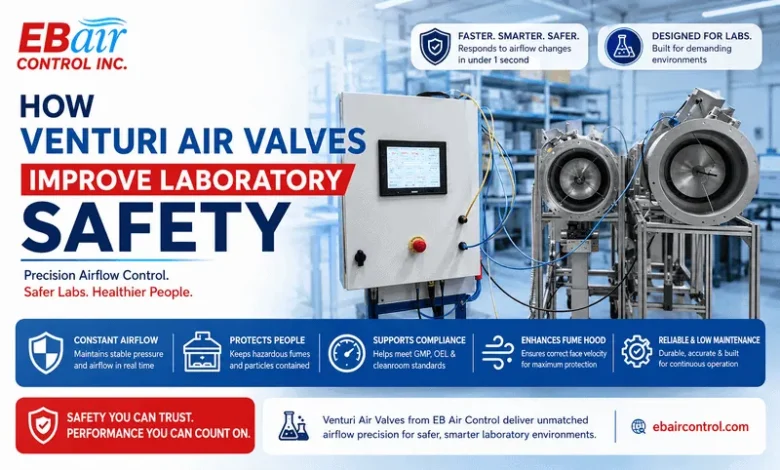
Walk into any laboratory. The most obvious thing that you’ll see is not the equipment or chemicals but the sound of the ventilator that is running behind the scenes. The constant flow of air doesn’t only sound like background noise. It’s the reason why we keep our space secure.
Corrosive chemicals, toxic fumes, and airborne bio-agents emit into air. This can affect worker safety and indoor air quality. Laboratories deal with these more than any other work environments. The ventilation system can be the only thing that stands between the dangers and workers who work around the area. If the airflow isn’t working correctly the results could be severe.
That’s where venturi air valves for laboratory safety come in. They’ve quietly become one of the more important pieces of technology in modern laboratory HVAC design, not because they’re flashy, but because they solve a problem that conventional systems have struggled with for years.
The Real Problem with Laboratory Airflow
Most smart laboratory ventilation systems work reasonably well under stable conditions. However, labs do not always remain steady. In a normal day the fume hoods can be closed and opened, exhaust volumes change, and the pressure of ducts fluctuate continuously. Each of these changes put stress on the capacity of the system to ensure proper airflow.
Traditional pressure-based systems respond to these fluctuations by sensing the change and then making an adjustment, but that takes time. In a general office building, a two or three-second lag in airflow response doesn’t matter. In a biosafety laboratory or a pharmaceutical research facility, it absolutely does.
Venturi Air Valves take a different approach. Rather than waiting for a sensor to detect a pressure change and trigger an adjustment, the valve responds mechanically and almost instantly. The EB Air Control system, for example, reacts to airflow changes in under one second. That kind of response time isn’t a minor specification detail, it’s the difference between a contained hazard and an escaped one.
What This Means for the People in the Lab
Typically, the lab staff don’t think much about the ventilation system while at work. However, if airflow control fails, or doesn’t work even if for a short time, chemical vapours or airborne particles can start drifting in the wrong direction rather than moving out of the room.
Venturi Air Valves keep exhaust and supply airflow stable and coordinated. Because the system adjusts so quickly to pressure changes, contaminants stay on the intended path, out of the space, not into it. For researchers working with hazardous materials day after day, that consistency matters more than most of the other equipment in the room.
Fume Hoods Only Work When the Airflow Works
Fume hoods are designed to capture and exhaust dangerous vapors before they reach the person using them. It’s a simple enough concept, but the execution depends entirely on maintaining the right face velocity, the rate at which air flows into the hood opening.
When system pressure changes cause exhaust airflow to drop unexpectedly, face velocity drops with it. The hood looks the same, but its protective function is compromised. A researcher working in that hood has no obvious way of knowing.
Venturi Air Valves keep a constant airflow through the fume hood airflow control system and prevent the situation regardless of what else is going on in the duct network. The system also monitors the exhaust and supply airflows together to maintain the overall balance of the room instead of just managing each component in isolation.
Positive and Negative Pressure: Why They’re Hard to Maintain
Not all laboratories are designed the same way. Biosafety labs typically run with negative pressure. The air is pushed in, but it does not let it out by itself and keeps the bio-agents in the room. A cleanroom for pharmaceuticals typically runs with positive pressure. Air is forced out to stop outside contaminants from entering.
These two setups appear simple until you consider what happens in a real laboratory: doors that open and close, the need for ventilation changes, and rates of exhaust shifts. Any of these can temporarily knock the pressure balance off target.
Venturi Air Valves handle this by precisely controlling both the supply and exhaust sides of the system simultaneously. The result is that the room maintains its intended pressure offset even when conditions around it are changing. This matters not just for safety, but for regulatory compliance and for the integrity of whatever research is being conducted.
Accuracy That Holds Up Over Time
One of the less obvious risks in laboratory ventilation is calibration drift, when a system that was accurate when installed gradually becomes less so. Small inaccuracies in airflow control tend to compound, and by the time they become noticeable, they’ve often been affecting conditions in the lab for a while.
EB Air Control Venturi Air Valves are factory calibrated and maintain airflow accuracy within ±5% of the command signal. This consistency won’t diminish as sensor-dependent systems can. They also work with PLC controllers, Modbus, and BACnet, which means they can be used in modern automation of buildings instead of functioning in isolation as a distinct part.
Low Maintenance Isn’t Just a Convenience
Laboratories run continuously. Any system that requires frequent maintenance creates operational risk, not just the cost and effort of the maintenance itself, but the disruption to work that’s often time-sensitive or safety-critical.
Venturi Air Valves are designed around a mechanical, pressure-independent operating principle that simply doesn’t require much intervention. The EB Air Control system is rated for a turndown ratio of up to 20:1, operates independently of inlet and outlet conditions, and is specified as requiring no ongoing maintenance. For a facility manager overseeing a critical research environment, that kind of reliability isn’t a luxury, it’s a basic requirement.
Why This Technology Has Become Standard in Critical Facilities
Venturi Air Valves aren’t new; however, their use in lab environments has increased because safety standards have become more stringent, and the research labs have become more advanced. Their near-instant reaction as well as pressure-independent operation and the ability to predict long-term performance makes them appropriate for environments where laboratory airflow control isn’t only a concern for comfort. It’s also a safety issue.
Biosafety facilities, chemical labs, pharmaceutical production spaces, and hospital isolation wards are all places where the margin of error in ventilation is virtually null. Venturi Air Valves are designed with that reality in mind.
FAQs
What are Venturi Air Valves used for?
Venturi Air Valves help control and balance airflow in places like laboratories, hospitals, and pharmaceutical facilities where safe and stable ventilation is extremely important.
Why does response time matter in smart laboratory ventilation?
When working in a hazardous environment, an insignificant interruption to the control of airflow can cause dangerous particles or fumes to flow in the opposite direction. The sub-second response to mechanical action removes the delay that sensors can’t prevent.
Can these valves integrate with existing building systems?
Yes. They can support BACnet, Modbus, and PLC integration. They are suitable for most modern building automation and smart HVAC platforms.
Do they require calibration or maintenance after installation?
EB Air Control valves are factory-calibrated and intended to operate continuously without regular maintenance. This is an enormous advantage for installations that operate continuously.
Where are Venturi Air Valves used?
Chemical and biosafety laboratories, pharmaceutical manufacturing and QA settings, as well as hospital isolation units are some of the most common facilities that use venturi valves.