How Custom Metal Fabrication Supports Modern Pharmaceutical and Food Processing Equipment

Manufacturing industries continue evolving as production facilities demand more precision, efficiency, and compliance with strict safety regulations. This is especially true in pharmaceutical and food production environments where even small design flaws in processing equipment can affect product quality, cleanliness, and operational performance.
As industries become more specialized, companies increasingly rely on advanced Metal Fabrication solutions to build customized systems capable of meeting exact operational requirements.
From stainless steel blending systems to sanitary storage tanks and processing vessels, custom fabrication now plays a major role in helping manufacturers maintain efficiency while meeting strict regulatory standards.
According to the U.S. Food and Drug Administration (FDA), properly designed manufacturing equipment is essential for preventing contamination and supporting safe production processes in regulated industries. (fda.gov)
Why Precision Fabrication Matters in Regulated Industries
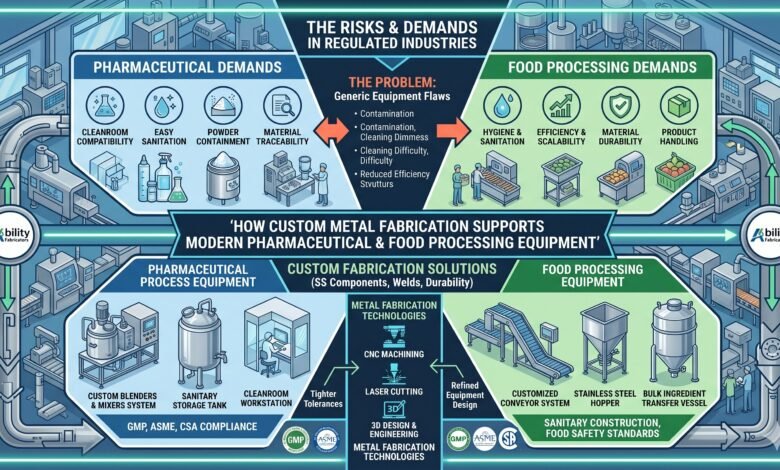
Industries such as pharmaceuticals and food processing cannot rely on generic equipment alone. Their operations often require systems designed around specific production volumes, sanitation requirements, ingredient handling processes, and facility layouts.
Poorly fabricated equipment may lead to:
- Product contamination
- Cleaning difficulties
- Reduced efficiency
- Material buildup
- Regulatory compliance issues
- Increased maintenance costs
Custom fabrication helps solve these problems by creating equipment specifically engineered for the operational environment.
The Growing Demand for Advanced Processing Equipment
Manufacturers continue investing in upgraded processing systems because production standards are becoming more demanding each year.
Changing Pharmaceutical Manufacturing Requirements
Modern pharmaceutical manufacturing equipment must support highly controlled environments where accuracy, cleanliness, and repeatability are essential.
Production systems are now commonly designed to support:
- Cleanroom compatibility
- Easy sanitation
- Powder containment
- Batch consistency
- Automated controls
- Material traceability
Regulatory agencies also continue increasing focus on documentation and process validation.
Modern Food Processing Challenges
The food processing industry equipment sector faces similar demands related to hygiene, efficiency, and production scalability.
Food manufacturers require equipment capable of handling moisture, acidic ingredients, temperature changes, and continuous cleaning procedures without corrosion or structural degradation.
The Importance of Hygienic Design
Sanitary equipment design has become one of the most important considerations in modern manufacturing.
Smooth welds, polished stainless steel surfaces, proper drainage angles, and contamination-resistant construction all contribute to safer production environments.
How Metal Fabrication Supports Industrial Equipment Performance
Custom fabrication affects nearly every aspect of industrial equipment reliability and functionality.
Custom Stainless Steel Components
Stainless steel remains one of the most commonly used materials in regulated manufacturing environments because of its durability and corrosion resistance.
Fabricated stainless steel components are widely used for:
- Blenders
- Tanks
- Conveyors
- Hoppers
- Pressure vessels
- Cleanroom equipment
Different grades such as 304 and 316L stainless steel are selected depending on sanitation requirements and chemical exposure levels.
Precision Welding and Assembly
Welding quality directly affects both equipment performance and sanitation.
Poor welds may create small crevices where contaminants can accumulate, increasing cleaning difficulties and regulatory risks.
Precision fabrication techniques help ensure smoother finishes and stronger structural integrity.
Durability and Corrosion Resistance
Industrial processing systems often operate continuously under demanding conditions involving heat, pressure, chemicals, and moisture.
Proper fabrication methods improve long-term durability while reducing downtime and maintenance concerns.
Why Pharmaceutical Manufacturing Equipment Requires Specialized Fabrication
Pharmaceutical production environments involve strict regulatory oversight and highly sensitive manufacturing processes.
GMP and Regulatory Compliance
Custom pharmaceutical systems are commonly designed to meet GMP, ASME, CSA, and TSSA standards.
According to Ability Fabricators, regulated industries require fabrication processes that prioritize traceability, quality assurance, and sanitary engineering throughout production.
Cleanability and Sanitary Construction
Pharmaceutical equipment must allow efficient cleaning and sterilization procedures to reduce contamination risks between production batches.
Many systems are designed for CIP (Clean-In-Place) and SIP (Sterilize-In-Place) compatibility.
Consistent Production Standards
Consistency is critical in pharmaceutical manufacturing because even small production variations can affect product safety and quality.
Custom fabrication supports tighter tolerances and more controlled production environments.
The Role of Fabrication in Food Processing Industry Equipment
Food production facilities also require highly durable and sanitary equipment systems.
Food Safety and Sanitary Standards
Food-grade fabrication focuses heavily on preventing contamination and supporting efficient cleaning procedures.
Equipment surfaces must remain resistant to bacteria buildup, corrosion, and moisture-related damage.
Efficient Product Handling
Custom equipment helps improve production flow while reducing material waste and manual handling requirements.
Many facilities use fabricated systems for:
- Ingredient transfer
- Mixing operations
- Bulk storage
- Packaging support
- Conveyor integration
Equipment Designed for Long-Term Reliability
Food production often operates continuously for long shifts, making durability extremely important.
High-quality fabrication reduces repair frequency while improving operational stability.
Modern Fabrication Technologies Improving Manufacturing
Advanced fabrication technologies continue improving precision and customization capabilities.
CNC Machining
CNC machining allows manufacturers to produce complex parts with highly accurate dimensions and repeatability.
Laser Cutting
Laser cutting creates cleaner edges and more precise component shapes compared to traditional cutting methods.
3D Design and Engineering
Modern fabrication companies increasingly use advanced modeling software to test equipment layouts and improve production efficiency before manufacturing begins.
According to Ability Fabricators, engineering and 3D modeling services help manufacturers refine custom process equipment before production starts.
How Ability Fabricators Supports Industrial Manufacturing
Ability Fabricators specializes in custom stainless steel and metal fabrication solutions for pharmaceutical, food processing, chemical, and nutraceutical industries.
Their services include:
- Custom fabrication and assembly
- Process equipment design
- Stainless steel tanks
- Blenders and mixers
- Pressure vessels
- Quality control and assurance
- Engineering and consulting
The company also emphasizes compliance with GMP, ASME, CSA, and TSSA standards while managing engineering, fabrication, and quality control in-house.
Final Thoughts
Modern pharmaceutical and food manufacturing facilities require far more than standard equipment. Precision, sanitation, durability, and regulatory compliance all play critical roles in maintaining safe and efficient production environments.
Custom Metal Fabrication helps manufacturers create equipment systems designed specifically for their operational requirements while supporting long-term reliability and performance.
As demand for advanced pharmaceutical manufacturing equipment and reliable food processing industry equipment continues growing, custom fabrication will remain an essential part of industrial manufacturing innovation.